
Types of Book Editing Explained
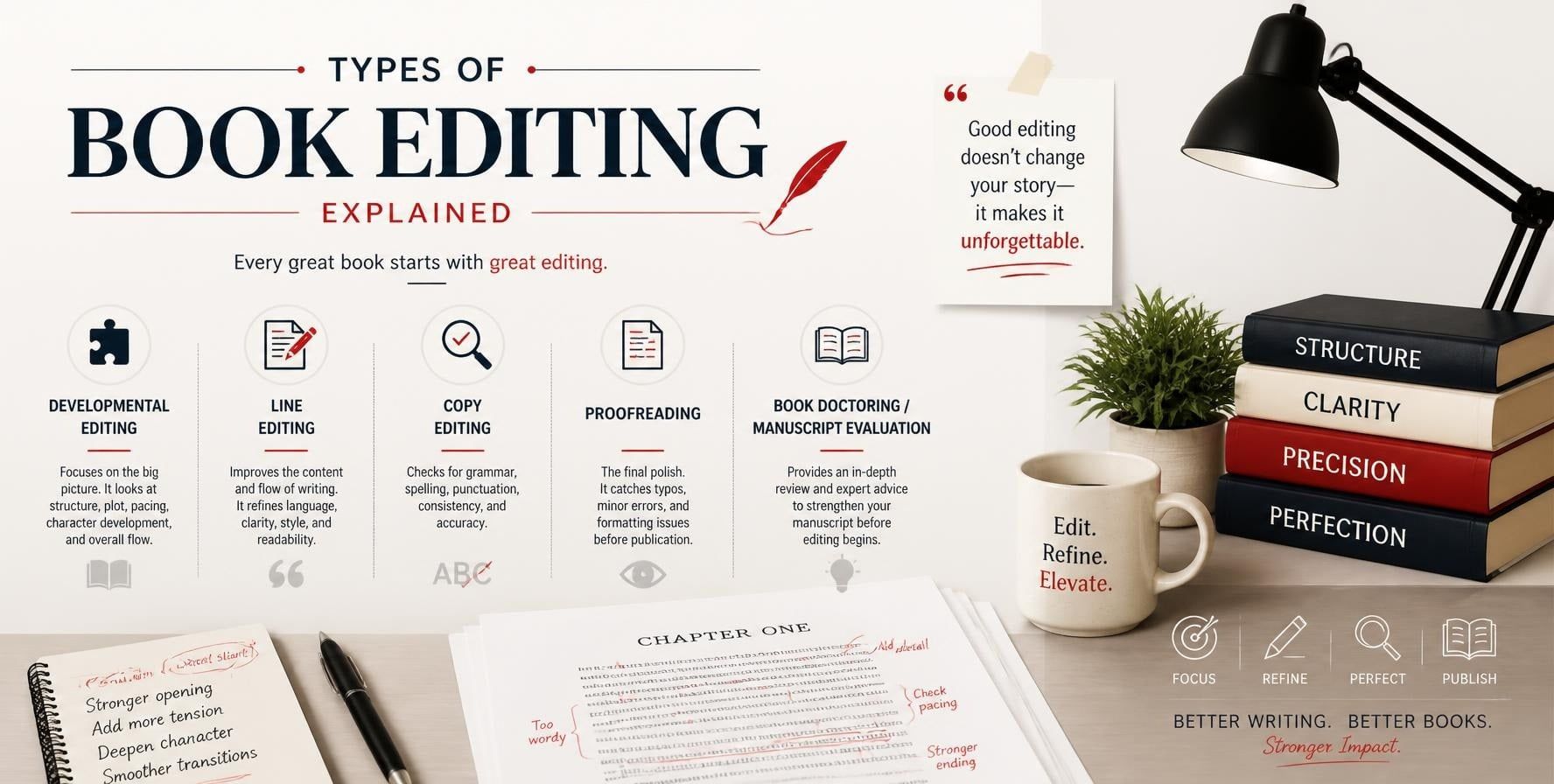
Editing is not a single step. Different stages focus on different areas of a manuscript. Developmental editing helps improve the overall direction; structural editing strengthens the organisation of chapters; line editing refines the writing style; copy editing focuses on accuracy and consistency, and proofreading checks the final version for remaining mistakes.
Writing a book involves a lot of hard work for the authors. A manuscript may contain a strong story and creative concepts, but the quality of the final book depends heavily on how well those ideas are improved before publication.
This is where book proofreading and editing do the magic. So continue reading to understand the different types of editing to find the right support for your manuscript.
What is Book Proofreading and Editing?
The terms refer to the process of reviewing and refining a manuscript before it is published. Both stages play an important role because a manuscript can be well-written but still contain mistakes that affect the reader’s experience.
The Difference Between Editing and Proofreading
The key differences between book proofreading and editing are:
| Editing | Proofreading |
| Editing focuses on improving the quality of the manuscript by working on areas such as storytelling and consistency. | Proofreading checks the final version for errors that might have been missed during earlier stages. |
| This process involves rewriting sections, which depend on the stage of the manuscript. | It focuses on finding remaining errors such as spelling mistakes and formatting problems. |
| Editing usually takes place before the final manuscript is prepared for publication. | Proofreading is one of the final steps completed before printing or publishing. |
Why Both Are Essential Before Publishing
These author services are valuable for anyone who is preparing to self-publish. A polished manuscript creates a better impression on readers and increases the chances of producing a professional-quality book.
Types of Book Editing
Each manuscript requires a different type of editing. A first draft usually needs more detailed attention than a manuscript that has already gone through several revisions.
Here are the main stages that you should know about before searching for book editing services near me.
Developmental Editing
Developmental editing is often the first major stage of professional manuscript editing. It focuses on the bigger picture rather than individual sentences.
A developmental editor reviews whether the book works as a complete piece. They examine elements such as the storyline and overall direction.
For fiction writers, this may involve looking at:
- character motivations and development
- plot progression
- pacing between chapters
- whether the ending feels satisfying
Developmental editing may involve checking whether the information follows a logical order and whether the content delivers value to the intended audience for non-fiction writers.
For example, a business book may contain excellent advice but present ideas in a confusing order. A developmental editor can help reorganise the chapters so readers can follow the author’s message more easily.
This stage is especially useful for first-time authors who may be too close to their own work to notice weaknesses.
Structural Editing
Structural editing focuses on how the manuscript is organised and presented.
This type examines the arrangement of chapters and information flow.
A structural editor may ask questions such as:
- Does each chapter serve a clear purpose?
- Are ideas introduced at the right point?
- Does the book maintain reader interest from beginning to end?
- Are any sections unnecessary or repetitive?
Structural editing can be very helpful for children’s book authors. The story needs to match the reading level and expectations of young audiences.
This type of editing helps create a smoother reading experience before moving into detailed language improvements.
Line Editing
Line editing focuses on how the writing sounds and feels from the reader’s perspective. At this stage, the editor looks closely at sentence flow and the overall style of the manuscript.
A book can have a strong structure but still feel difficult to read if the language is unclear or repetitive. Line editing helps refine the author’s writing while keeping their original voice intact.
A line editor may improve:
- sentences that feel too long or difficult to follow.
- sections where the tone does not match the intended audience.
- repeated phrases that weaken the impact of the writing.
- descriptions or explanations that need more clarity.
Line editing can make dialogue feel more natural and descriptions more engaging for fiction writers. Non-fiction authors can get the benefit of simplifying complicated ideas without removing important details.
Copy Editing
Copy editing focuses on consistency and technical quality. It is one of the most important steps before a manuscript moves towards final preparation.
A copy editor checks areas such as grammar, spelling, punctuation, sentence structure and consistency throughout the book.
For example, a manuscript may use different spellings of the same word and switch between writing styles that distract readers. Copy editing identifies these issues and creates a more polished reading experience.
A copy editor may also check:
- Whether characters’ names and important dates stay consistent.
- Any punctuation or formatting issues that could distract readers.
- If the writing style suits the people the book is written for.
Copy editing provides an additional level of quality control before the manuscript moves towards book formatting and publication for authors working on self-publishing projects.
Proofreading
Proofreading is the final quality check before a book reaches readers. It focuses on catching the small mistakes that may have remained after editing.
An expert from a book proofreading company reviews the final manuscript for:
- Spelling mistakes and other overlooked errors.
- Punctuation issues that affect readability or clarity.
- Formatting inconsistencies between chapters or paragraphs.
- Missing words or accidental omissions.
- Layout issues that may have appeared during the book formatting process.
Even experienced writers benefit from proofreading because it is difficult to spot mistakes in your own work after reading the same content many times.
How to Choose the Right Editing Service
Choosing a professional book proofreading and editing service depends on where you are in your writing journey. A lot of authors make the mistake of hiring the wrong type of support because they are unsure what their manuscript actually needs.
You need to consider the following factors before choosing an editing service.
Look at Your Manuscript Stage
The condition of your manuscript is the first step in guiding your decision.
If you have only completed the first draft, developmental editing can provide the most value because the main focus should be improving the book’s direction.
If your manuscript is already well-developed, you may only require line editing or proofreading before publication.
A professional manuscript review can help identify which stage is most suitable.
Consider Your Genre
Each type of book will require a specific approach.
- In a thriller or romance novel, editors often pay close attention to pacing and whether the characters feel believable.
- For business guides and educational books, the priority is making ideas easy to follow and logically organised.
Children’s book authors also need specialised support because young readers have specific language requirements. Writers exploring children’s book publishing often need editors who understand age-appropriate vocabulary and the relationship between text and illustrations.
Think About Your Publishing Goals
Your editing requirements may also depend on how you plan to publish your book.
Authors submitting work to traditional publishers often need a polished manuscript that meets professional expectations. Independent authors who choose self-publishing have the same responsibility to deliver a quality reading experience.
Searching for best book editing services near me can help authors find local support, but location should not be the only deciding factor. Experience and understanding of your genre matter just as much.
Why Professional Book Editing Matters
Every author knows that their book deserves a careful presentation.
Professional editing transforms a draft into a manuscript that feels well- organised and ready for readers.
Improves Readability
Editors help improve the overall flow so the book feels smoother from the first page to the last.
Eliminates Errors
Book proofreading companies and professional editors provide the final checks needed to maintain accuracy for a professional finish.
Enhances Credibility
A carefully edited manuscript shows attention to detail and creates a stronger impression, whether the book is non-fiction or a children’s publication.
Authors searching for top book proofreading companies should look for providers that understand both language quality and publishing standards.
Prepares the Book for Publication
Editing support can make the journey more manageable for authors entering the self-publishing process. Instead of handling every stage alone, writers can work with professionals who understand manuscript preparation, book formatting and publishing requirements.
Why Choose SelfPublishing.ie?
Writers who are comparing top book publishers near me need support at different stages, from reviewing their ideas to preparing the final version for readers.
SelfPublishing.ie provides authors with professional guidance throughout the publishing journey, including editing and manuscript preparation.
Here is what they have to offer for confused authors.
Professional Book Editing Services
SelfPublishing.ie offers professional book editing services designed to help authors improve their manuscripts before publication.
The editing process focuses on strengthening the content while maintaining the author’s original voice. Experienced editors review manuscripts carefully and provide support based on the needs of each project.
Expert Proofreaders and Editors
SelfPublishing.ie works with skilled proofreaders and editors who understand the importance of consistency and readability.
Their support covers different stages of editing, including manuscript refinement, copy editing and final proofreading.
This allows authors to identify issues they may have missed after multiple rounds of self-editing.
Manuscript Review and Feedback
Identifying the specific chapter that requires editing is one of the most difficult tasks for authors.
Self-publishing.ie reviews the structure and overall quality of a manuscript to recommend suitable next steps. This gives authors a clearer understanding of what their book needs before moving forward.
Self-Publishing Guidance
Alongside editing and book proofreading help, SelfPublishing. i.e., guides the self-publishing process for first-time authors.
Authors can access this support for the whole journey from preparing manuscripts to understanding publishing requirements.
Children’s Book Publishing Support
Children’s books require a different approach compared to many other genres.
SelfPublishing.ie supports authors interested in children’s book projects by considering factors such as reading level and the way words work alongside illustrations to create a stronger experience for children.
FAQS
What is the difference between book editing and proofreading?
Book editing aims to improve the quality of the manuscript, whereas proofreading is done to check for any mistakes like spelling and formatting.
Which type of editing does my book need?
This will depend on where you are with your manuscript and what kind of editing it requires. Early drafts may require development editing or structural editing, but finished drafts need copy editing or proofreading.
Do I need professional book proofreading before publishing?
Yes. Proofreading is the last step of writing that helps catch any errors in your book that you may have overlooked in previous stages of writing and editing.
How much do book editing services cost?
It depends on the length of the manuscript and other variables. A manuscript review can be helpful in deciding the best services for you.
When should I hire a book editor?
Once you have completed your manuscript and have revised it yourself, you can hire an editor to prepare your manuscript for publication.
Wrapping Up
A finished book represents an author’s months of creativity and dedication. Giving that manuscript the right editing support is necessary to ensure readers experience the story exactly as the author intended. This is why professional book proofreading and editing from a reputable service provider, such as selfpublishing.ie should be on the checklist of every author.

I am a seasoned author, editor, and self-publishing strategist with a passion for helping writers navigate the journey from manuscript to published book. With years of experience in the Irish and international publishing scene, she writes practical, actionable blog posts covering everything from book formatting and distribution to marketing and platform building. my insights help aspiring authors demystify the publishing process and build sustainable careers as independent writers.